Written by María José Calvimontes, PhD
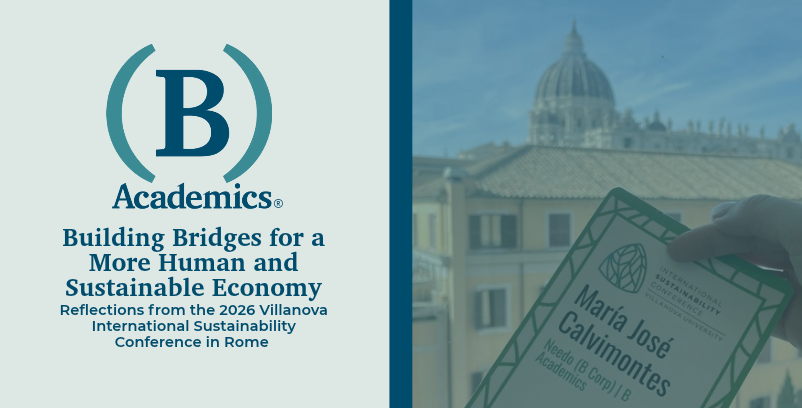
What if one of the greatest obstacles to a more sustainable economy is not a lack of knowledge or solutions, but the distance between people already working toward the same goals? That question accompanied me throughout the 2026 Villanova International Sustainability Conference, held in Rome from October 12–15 under the theme Responding to the Cries of the Earth and the Poor.
The conference brought together more than 350 academics, researchers, business professionals, religious leaders, and civil society representatives. Inspired by Pope Francis and Laudato Si’, his 2015 encyclical calling for care of our common home through an integrated approach to social and environmental challenges, it created a space for dialogue across disciplines, cultures, and beliefs.
As a sustainability professional and researcher, I participated bringing two interconnected perspectives: Needo, a B Corp in Chile, and B Academics, our global community advancing research and education on B Corps and sustainable business. Beyond sharing these perspectives, the experience revealed an extraordinary community of people whose work and aspirations resonated with my own, reinforcing a conviction that would accompany me throughout the conference: connecting people matters as much as the knowledge we produce.
Integral ecology: seeing the whole picture
A recurring message in Rome was that environmental, social, and economic challenges cannot be addressed in isolation. Integral ecology, central to Laudato Si’, recognizes the interdependence of human dignity, social justice, economic activity, and the natural environment. The well-being of people and the health of the planet belong to the same conversation.
This speaks directly to my professional and academic experience. For more than two decades, I have worked at the intersection of strategic communication, organizational culture, and sustainability. Through Needo and my research, I have seen what companies can achieve (and where they struggle) when they seek to embed social and environmental responsibility in their decisions and daily practices.
One conviction has grown stronger over time: economic transformation is also a cultural and human transformation. New business models, standards, and measurement frameworks matter. Yet lasting change also depends on how people understand the purpose of business, exercise leadership, make decisions, and relate to one another. Sustainability cannot remain an initiative alongside business as usual; it needs to shape an organization’s culture.
The B Corp movement offers a practical expression of this aspiration through businesses committed to considering their impact on workers, communities, customers, and the environment. The vision of integral ecology also reminds us that business transformation is part of a wider effort involving education, research, public policy, and civil society.
Here, I see a natural meeting point with B Academics: an invitation to question fragmented approaches and explore how economic activity can serve both people and the planet. This is also why organizational culture deserves serious attention in sustainability research. Commitments become credible when they are reflected in everyday conversations, relationships, incentives, and choices; not only in mission statements or public reports.
When knowledge becomes action
The speakers brought different experiences to this shared challenge. Robert D. Bullard, a pioneer of environmental justice, showed why environmental risks and social inequalities must be examined together, particularly through the experiences of vulnerable communities. Cardinal Michael Czerny, recipient of the inaugural Pope Leo XIV Sustainability Medal, emphasized the moral responsibility to hear the cries of people and the Earth. Wanjira Mathai drew attention to community engagement and the relationship between environmental restoration and human well-being.
Their contributions left me with a question central to the work of B Academics: How can knowledge help change not only what organizations do, but also how they think and operate? Research can test assumptions, identify gaps, and build evidence about more responsible business models. Education can equip future leaders to rethink the role of business. Collaboration with practitioners can bring that knowledge into decisions, workplaces, and communities.
For this to happen, academic institutions must engage with realities beyond their walls. We need spaces where disciplines meet, evidence encounters lived experience, and researchers and practitioners learn from one another. Rome offered an inspiring example. The sessions moved between environmental justice, technology, housing, partnerships, and practical responses to complex challenges. Their range made the point unmistakable: no single discipline, sector, or institution holds all the answers.
The conversations between sessions
Some of my most memorable moments happened away from the stage: over coffee, at shared meals, and in conversations that began with simple curiosity. I spoke with researchers, university representatives, sustainability professionals, and community leaders from the United States, Europe, Africa, Latin America, and elsewhere. I introduced many to B Academics and the B Corp movement. Some already knew B Corps; for others, the concept was new.
What stayed with me was how much common ground we found. Across very different settings, people were advancing approaches to development rooted in social justice, environmental responsibility, and human dignity. Often, we shared ambitions without sharing networks.
I was especially encouraged by conversations with African community leaders, whose perspectives brought the realities of local action into a gathering with a strong academic presence. They reminded me that the people living closest to a challenge should also help shape the questions we ask about it.
How many promising collaborations never begin because the people who could make them possible have not met? This is one of the great opportunities for B Academics. Alongside publications, research projects, and educational initiatives, our community can connect expertise across regions and sectors. A conversation can lead to an introduction; an introduction, to a joint project; a joint project, to changes neither partner could achieve alone.
I went to Rome hoping to share a perspective. I came away more convinced of the importance of being a bridge.
Why voices from the Global South matter
Arriving from Chile made me especially conscious of whose perspectives are present in international sustainability discussions. South Americans were a small minority at the conference; to my knowledge, only two participants had traveled from Chile.
Representation matters because the Global South experiences many of the sharpest consequences of environmental degradation and inequality. Yet our regions are also sources of research, creativity, practical innovation, and collective solutions.
Latin America has an expanding ecosystem of universities, researchers, B Corps, social enterprises, and organizations experimenting with new ways of doing business. Our contribution to international dialogue should not be limited to describing our challenges. We have knowledge and experiences that can reshape how sustainable business is understood elsewhere.
For B Academics, this calls for strong regional communities, including B Academics LATAM, and more opportunities for knowledge to travel in multiple directions: North to South, South to North, and between countries and regions whose experiences rarely meet. Building these exchanges requires listening as much as speaking, and approaching other regions as partners in producing knowledge rather than simply places where ideas are applied. A truly global academic network can do more than expand its reach. It can broaden the questions we ask, the evidence we value, and the solutions we imagine.
Different beliefs, a shared responsibility
Another source of hope was the openness of a gathering rooted in Christian thought and the legacy of Pope Francis. People of different beliefs and cultural backgrounds found common purpose in the conviction that human dignity, social justice, and environmental stewardship belong together. I found this deeply meaningful. An ethical foundation, expressed with respect and openness, can invite dialogue rather than close it down.
In Rome, differences did not prevent genuine encounters; they enriched them. For sustainable business, that lesson matters. Technical tools alone cannot generate the trust, empathy, or willingness to cooperate that enduring change requires. Sustainability is also about how we relate to colleagues, communities, future generations, and the living world.
Carrying the connections forward
I am deeply grateful to Villanova University and everyone who made the conference possible. Rome offered rigorous ideas, challenging questions, and, above all, encounters that gave those ideas a human face. I returned to Chile with hope grounded in the people I met: researchers committed to justice, educators preparing new generations, practitioners questioning established models, and community leaders creating change where they live.
For B Academics, these encounters point to an exciting responsibility: to nurture a global community where knowledge circulates, different perspectives are welcomed, and relationships grow into collaboration.
My professional purpose has long been to communicate, connect, and collaborate for social and environmental good. In Rome, I experienced those three verbs as something tangible: conversations opened doors, shared concerns became invitations, and strangers began to recognize one another as potential partners.
I believe economic transformation begins there, too: in our values, cultures, and relationships. Every bridge we build creates another possibility for knowledge to become action, and for action to contribute to a more human and sustainable economy.
 Upcoming Events