Written by Federica Massa-Saluzzo
“Or I am mad, or else this is a dream… If it be thus to dream, still let me sleep!”
This is what William Shakespeare wrote in Twelfth Night, and it perfectly captures the experience I am living. Since December 2025, I have been spending a sabbatical period in Japan. I will be here until the summer.
Shakespeare was probably not inspired by an academic on sabbatical when he wrote those famous words, and yet this full immersion in such a different culture is an opportunity I would wish for every colleague. It is helping me refresh and reconfigure my trajectory as both a researcher and a teacher. I will try to summarize the most relevant aspects.
Doing a sabbatical on the other side of the world feels a bit like changing identity, like being reborn—but not from scratch. Rather, you arrive with a backpack full of what I would call “credits of trust.” Thanks to these credits, generously granted by the B Academics community, I have been welcomed in Tokyo with enthusiasm and extraordinary generosity. A generosity that has allowed me to build connections that are proving fundamental for my research on governance and local impact ecosystems.
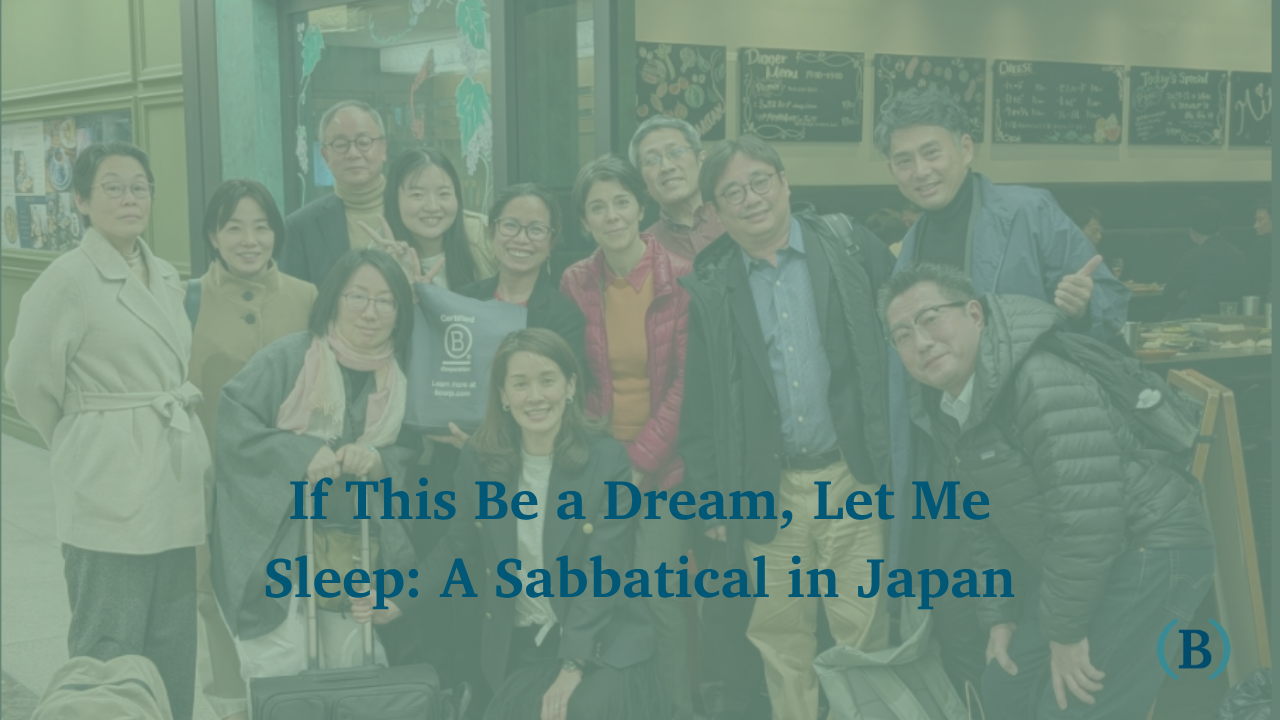
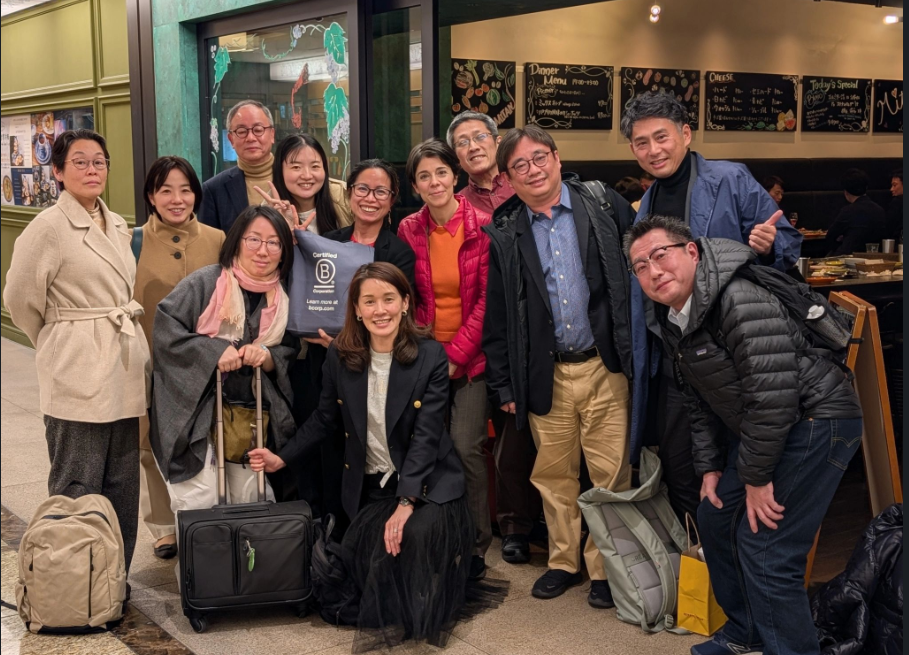
The B community here in Tokyo deserves special recognition. This growing community represents a unique example of how the B Corp movement is adapting to different institutional contexts. Through collaborations between actors such as the Japan Research Institute, universities like Waseda Business School, and broader academic networks such as the Japan Forum of Business and Society, an ecosystem is being built that connects research, education, and practice. With more than 70 B Corps in the country—an increase of over 1500% in five years—and growing interest from academia, the public sector, and companies, Japan is developing its own approach, deeply rooted in multi-stakeholder collaboration.
Rather than replicating existing models, this community is contributing to a reinterpretation of the role of business as a social actor from a situated perspective, emerging as a leader within the global movement. As I have heard many times since arriving here, Japan may not be the fastest to adapt to new paradigms, but when it embraces change, it does so deeply and in ways that are almost irreversible. This is precisely what is happening within the ecosystem of research, education, and practice that I have the privilege to observe.
Another key aspect of my experience has been gaining a new perspective on my research. Many of the assumptions I took for granted about systemic change and sustainability do not fully apply here. For instance, the strong role of regulation—so central in Europe—is almost absent here. There is no equivalent of a supranational entity shaping sustainability standards, strong competitive pressures like in the U.S., and civil society, I have learned, does not have the same persuasive power it holds in Europe or the US, being more closely connected to governmental structures.
So how does systemic change happen?
A recurring narrative I have encountered is that of “disaster.” In Japan, it is not government regulation that primarily drives sustainability transitions, but rather the deep awareness of impermanence. The country has experienced wars that have profoundly shaped its identity, and frequent earthquakes, along with the overwhelming force of nature, have led people to internalize a sense of impermanence and the superiority of nature. This, I am beginning to understand, is a fundamental driver of systemic change.
This realization is highly relevant for how I—and many Western academics, particularly in Europe—understand and study sustainability. It invites us to question our regulatory-centric frameworks and to recognize that cultural, historical, and existential dimensions may play a far more significant role than we tend to acknowledge.
Finally, there is a more personal dimension to this experience: family life. I have had the privilege of coming to Tokyo with my family, and what is, on one hand, a great opportunity—being temporarily detached from the rest of the world—can also be challenging when you have a young child and no extended family or support system nearby. This experience has allowed me to redesign a new and unexpected family routine, where the quality of time takes on a different meaning and allows us to appreciate more deeply the essence of family life.
Here again, the sense of impermanence so central to Japanese culture accompanies me, reminding me to savor every moment of these gifts, knowing that in a few months this experience will come to an end.
To conclude, I am deeply grateful to EADA for this opportunity, to my colleagues for covering the teaching I could not deliver from afar, and especially to the wonderful B community here in Japan—particularly Nozomi Torii, Makiko Hashizume, Maki Kanetaka, Lailani Alcantara, Kanji Tanimoto, Tamako Watanabe, Kanon Minami, and many others—who are giving me one of the most enriching periods of my career.
Thank you. And now, I will continue to dream.
 Upcoming Events